| |
| |
Telecine guidelines
for negative dailies |
In order to expedite dailies in our telecine facility, we ask that the production follow the guidelines listed below:
Slates:
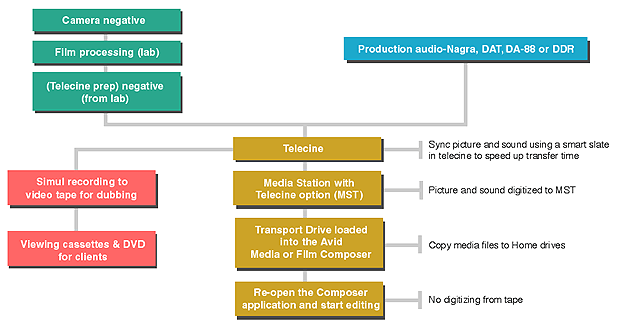
Slates should have normal information including: Camera Roll, Scene, Take, Sound Roll Number, Production Number and Date. It's productions responsibility to make sure this information is updated and current for ALL takes. Slates should be visible to the camera and held in frame long enough to provide clear readable time code and stix. Avoid using "Tail Stix" - those just add to the transfer time.
Use "Smart" slates with audio time code for all cameras (time of day code). Re-jam the slate to the Time Code source as often as possible. Include the time code of the "Clapper Close" on the sound log report for each take.
Audio:
Audio pre-roll should be a minimum of 8 to 10 seconds stable running time code - the longer the better. This allows enough time to show slates and establish a "zero frame" KeyKode number with running stable time code. Preroll rules includes wild tracks, allowing audio identification can be included in the slate.
Tones should be recorded at the head of every sound roll with date/roll number, etc., - suggested reference level of -8 dB Analog or -18dB Digital.
All "A" camera takes on the audio roll should have a voice identificationand be noted on a sound report. Note additional "B," "C," etc. cameras on log sheet.
Logs:
If only "Circle Take" transfers are required, Camera and Sound Logs need to be matched before film can be transferred. If they don't, the transfers will take longer as we justify both logs. Include script notes if possible. This keeps dailies transfer more efficient.
Camera log should note day/night, interior/exterior and any additional notes from the director of photography that are necessary.
Sound log should include split track information, time code for each take (including wild tracks) and information notes.
Additional guidelines:
Shoot a gray scale chart at the beginning of each new set-up.
Before production starts, during the camera test, shoot a Framing Chart.
Use Nagra center track NDFTC audio when transferring to NDFTC video.
All Field recorders should be recorded at 30 frames per second, NOT 29.97.
Non Drop Frame Time Code (NDFTC) is preferred.
We guarantee audio to be in sync within plus or minus 3 fields at clapper close.
Try not to use "Tail Stix." Sync time takes longer.
Roll Camera and Sound as long as possible before "Clapper Close" for faster syncing.
|